Investor vs Investment Performance
This is the fundamental principle that defines my Advisor philosophy.
Quote
-
“The best investors in the world are really good at doing nothing for long periods of time." ―Michael
-
“The investor is more important than the investment." ―Dick Fabian
How Can The Driver Be Slower Than The Car He's Driving In?
If you compare the average speed of a driver in a car to the average speed of the car, how would it be possible that the two are different?
Here's how: a car traveling on a specific route usually moves at a rate of 60 mph, but our particular driver frequently takes breaks or second-guesses the pre-planned route and takes detours; thus his average speed is less than 60 mph.
Investors do the same thing: they invest in a mutual fund that averages ~12% over all ten year periods (such as the American Funds ICA), yet they only get a 10-year return of 6% because instead of investing and leaving it alone, they pull their money out when the market drops and re-investment when market is up (selling cheap and buying expensive).
Then they blame "the market", the mutual fund and even their Advisor. The driver is blaming the car or the pre-planned route instead of himself.
Quote
“Investing is easy, it's clients that get in the way" ―Michael
Take a look at the chart below which shows the average rate-of-return over twenty years of the driver (investor) vs the car (the investment).

Source: Capital Group Literature number INGEFL-050-0522
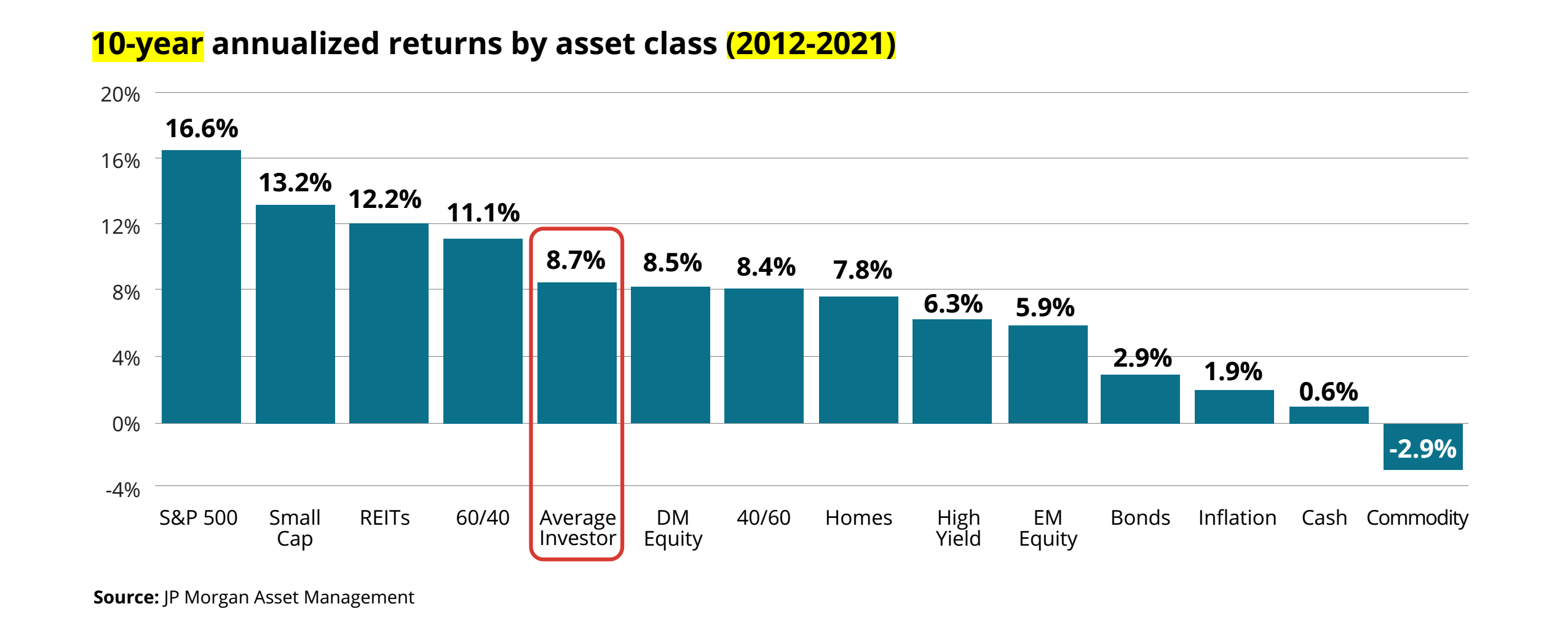
Source: JP Morgan
“We don’t manage money, we manage people.” ―Nick Murray
In my 37+ years of coaching clients, I've found the differences between the investor and the investment to be much more pronounced, especially over longer time-frames. Most investors without a coach aren’t disciplined enough to stay on track (ie, staying in the market when it's down).
Why Do They Do This?
Why do investors "get out of the car" or go off of the planned route?
Fear and Greed.
Driven by these emotions, clients often engage in such negative behaviors as chasing the hot manager or asset class, avoiding areas of the market that were out of favor, attempting to time the market, or otherwise abandoning their investment plan.
Quote
"If you cannot control your emotions, you cannot control your money." ―Warren Buffett
Great investors have understood that building long-term wealth requires the ability to control one’s emotions and avoid self-destructive investor behavior. This is where a professional advisor can help - preventing their clients from making the Big Mistake.
During periods of uncertainty, investors often gravitate to the investment media for insights into how to position their portfolios. While these forecasters and prognosticators may be compelling, they usually add no real value.
Quote
"Don’t try to time the market. It’s very, very difficult to do. There may be a couple of people in the world who can do it, but if there are, they’re not telling you." ―Ben Bernanke
The Wall Street Journal Survey of Economists from December 1982 – December 2010, showed that economists’ forecasts were wrong in 37 of the 57 time periods – 65% of the time!
Every public trade that's ever been transacted since the 1800's is logged in a computer(s) somewhere, and if by now a pattern to the market hasn't been discovered, it isn't going to be.
Quote
“The sole function of economic forecasting is to make astrology look respectable. There are two kinds of forecasters: those who don’t know, and those who don’t know they don’t know.” ―John Kenneth Galbraith
Do not waste time and energy focusing on variables that are unknowable and uncontrollable over the short term, like the direction of interest rates or the level of the stock market. Instead, focus your energy on things that you can control, like creating a properly diversified portfolio and staying in it!
My best clients have understood that building long-term wealth requires the ability to control one’s emotions and avoid self-destructive investor behavior (with my help).
Even If You Could Time the Market, It Doesn't Make Much of a Difference
The Solution: Do Nothing (Buy and Hold)
Quote
“Don't watch the market closely. Buy and hold is the best strategy. The money is made in investments by investing, and by owning good companies for long periods of time.” ―Warren Buffett
Stop watching and obsessing over the market! Doing nothing is often the best investment strategy. Let the market do what it is supposed to do. You can't control it anyway, so don't try!
Quote
"When the spaghetti hits the fan, don't just do something: stand there. This too shall pass. You see, what happens in the equity market has very little to do with what actually happens to the equity investor. That's because the dominant determinant of long-term, real-life outcomes is not the performance of markets but the behavior of investors." ―Nick Murray
We can only control our participation in the market, and our behavior while we’re in it.
Quote
-
"Fidelity has done a study as to which clients had done the best at Fidelity. They were the people who forgot they had an account!" ―James O'Shaughnessy
-
“Investing is like a bar of soap… The more you touch it, the smaller it gets.” ―Darcy Howe
-
“If you spend more than 13 minutes analyzing economic and market forecasts, you’ve wasted 10 minutes.” ―Peter Lynch
-
"Personal finance is 80% behavior and only 20% head knowledge." ―Dave Ramsey
The Antidote: A Professional Advisor
Quote
“At the end of an investor’s life, less than 5% of his total lifetime return will come from what his investments did versus other, similar investments. The other 95% will come from how the investor behaved. And the primary determinant of that behavior will be the quality of the advice he got, or didn’t get.” ―Nick Murray
I am a long-term advisor serving clients with long-term goals. If a client is exhibiting short-term behavior or emotionally reacting to short-term market conditions, I need to have a serious discussion with him about his goals, and reassure him that a long-term perspective is the best perspective. My greatest value to my clients is my ability to influence their behavior in a positive way.
Quote
-
“The investor needs a confident, seasoned professional keeping him on the right track... making sure he stays diversified and insulated from his own tendencies toward greed and fear.” ―Nick Murray from his book Serious Money
-
“People make better decisions with financial advisors.” ―Robert Shiller, Nobel Prize-winning economist
-
“Without an adequately compensated advisor to help with selection and discipline, the individual investor will simply make all the classic and horrendous mistakes.” ―Nick Murray
-
“Proper investment strategy is as much of a psychological as an intellectual challenge. It is often best to seek professional help to structure and maintain a well-diversified portfolio.” ―Jeremy Siegel
To see how I implement this philosophy with my clients read WHAT I DO AND WHAT I DON'T DO.
What the Experts Say
-
"The investor is more important than the investment." ―Dick Fabian
-
"The dominant determinant of long-term, real-life financial outcomes is not investment performance, it's investor behavior. And the biggest determinant of one's behavior is the quality of the advice one gets, or doesn't get. An argument can be made that a professional Advisor's advice can add 6% of real-life returns to an investor's performance." -Nick Murray
-
“Proper investment strategy is as much of a psychological as an intellectual challenge. It is often best to seek professional help to structure and maintain a well-diversified portfolio.” ―Jeremy Siegel
-
"Psychology is probably the most important factor in the market and one that is least understood." ―David Dreman
-
"When the spaghetti hits the fan, don't just do something: stand there. This too shall pass. You see, what happens in the equity market has very little to da with what actually happens to the equity investor. That's because the dominant determinant of long-term, real-life outcomes is not the performance of markets but the behavior of investors." -Nick Murray
-
"Fidelity has done a study as to which clients had done the best at Fidelity. They were the people who forgot they had an account!" -James O'Shaughnessy
-
"Personal finance is 80% behavior and only 20% head knowledge." -Dave Ramsey
-
"Emotions are your worst enemy in the stock market." ―Don Hayes
-
"At the cornerstone of my convictions about wealth management is that one’s temperament trumps their intellect, one’s emotions supersede their agreements, and that human nature is the force which must be contended with above all others.” ―David Bahnsen
-
"If you cannot control your emotions, you cannot control your money." -Warren Buffet
-
“Individuals who cannot master their emotions are ill-suited to profit from the investment process.” ―Benjamin Graham
-
“Success in investing doesn't correlate with IQ.” ―Warren Buffett
-
“To be a successful long-term investor is easy in principle but difficult in practice. It is easy in principle because the strategy of buying and holding a diversified portfolio of stocks, forgoing any forecasting ability, is available to all investors, no matter what their intelligence, judgment, or financial status. Yet it is difficult in practice, because we are all vulnerable to emotional forces that can lead us astray.” ―Jeremy Siegel
-
“The investor's chief problem — and even his worth enemy — is likely to be himself.” ―Benjamin Graham
-
“I am thoroughly convinced that there are two predominant emotions or character traits that govern the investing habits of nearly all investors: Fear and Greed. The substantial preponderance of investing mistakes come from these two facets of human nature.
-
The existence of fear when things are bad is certainly not unnatural; an intuitive tendency to panic is part of human nature. This reality doesn’t make it any less destructive (and, I will add, it is a reality that properly trained wealth advisors were put on planet earth to counter-act). On the other side of the same coin is the greed that stems from the euphoria of when things are good—when risk and reality are clouded by what seems and feels like free or easy money. It can be character-based (“I heard my co-worker bragging about his wild returns, and now I have to find those same wild returns.”) or desperation-based (“I feel like I am behind in my retirement savings, but if I just have this one big hit, I will be back on track.”), but regardless of the motives driving it, when euphoric greed destroys clarity of mind, good things never happen in investing.” ―David Bahnsen