The Magic of Compound Interest
Written By Michael Paulding Thomas
What is Compound Interest?
It's interest that grows on the original principle, and then earns interest which is compounded on the whole amount and so on...
Quotes
-
"Compound interest is the eighth wonder of the world. He who understands it, earns it ... he who doesn't ... pays it." -Albert Einstein
-
“Compound interest is ugly in the early years, but beautiful in the later years.” ―Michael
-
“If you understand the math behind compounding you realize the most important question is not ‘How can I earn the highest returns?’ It’s ‘What are the best returns I can sustain for the longest period of time?’” -Morgan Housel
-
“My wealth has come from a combination of living in America, some lucky genes, and compound interest.” ―Warren Buffett
-
“We believe that, in general, compounding income over time — not style, sector, or asset class — is the most reliable driver of long-term returns.” ―Miller / Howard Investments
I used to think that the interest rate on an investment was pretty simple — you invest your money at 5% and get “X” in return. Then if your investment returned 10%, it would be “X” times two. Right?
WRONG. That's when over 35 years ago someone showed me a compound interest table and explained the magic of compound interest, which is one of the most amazing facets of financial management.
Compound interest is the interest calculated on the initial principal and also on the accumulated interest of previous periods. This means that interest is earned on both the initial amount and the interest that has been added to it over time.
Example
- If you deposit $100 at a 5% annual interest rate, at the end of the first year, you would have $105.
- In the second year, you would earn 5% on $105 (not $100), resulting in $110.25.
- This process of earning interest on interest occurs year after year and leads to exponential growth.
Examples of Compounding
Quote
“Compound interest is the most powerful force in the universe.” —Albert Einstein
Would you rather have $1,000,000 or a penny that is doubled every day for 30 days?
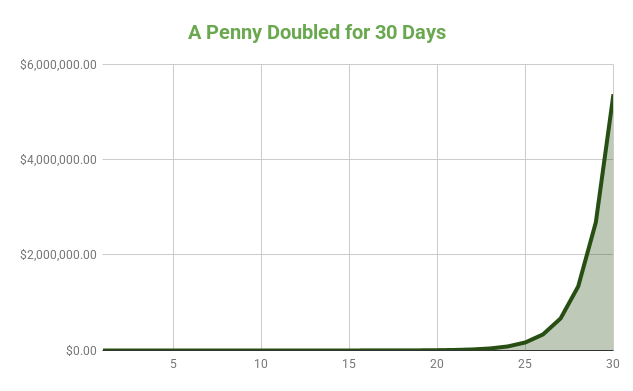
Doubling a penny 30 times = $5,368,709! (It actually only take 28 days to surpass $1M.)
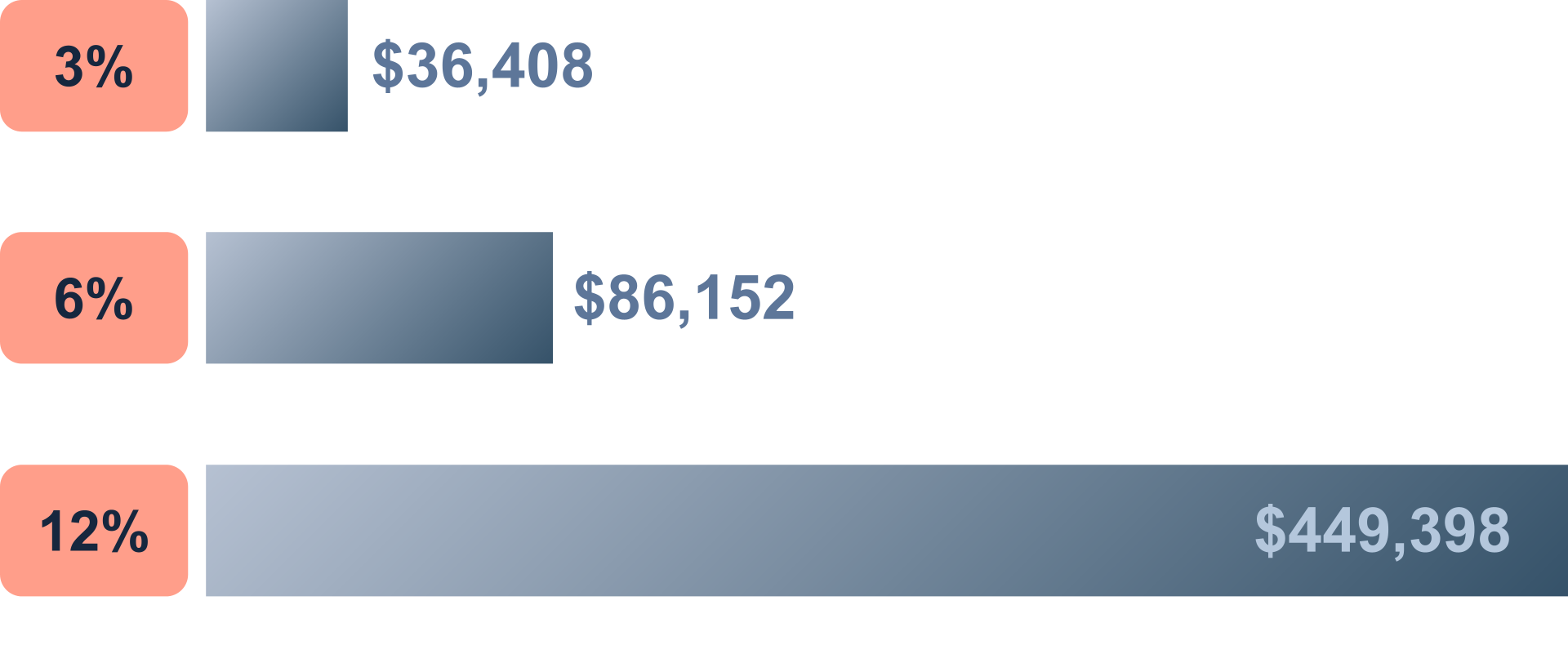
$15,000 One-Iime Investment For 30 Years
$15,000 ($1,250/month) is the maximum contribution for two IRAs (husband and wife).
Quote
"Never interrupt the compounding." ―Charlie Munger
When is $52,500 > $217,000 ?
| Contributions | Sam | Linda |
|---|---|---|
| Ages 28 - 35: | $7,500 | $0 |
| Ages 36 - 65: | $0 | $7,500 |
| Total Contributions: | $52,500 7 Years |
$217,000 30 Years |
| End Result @ 10%: | $1,128,706 | $1,114,731 |
In the above chart, we notice the following:
-
Fully-funding two IRAs for a married couple from age 25 to 65 (40 years of saving) and earning an average of 12% rate-of-return, will build them a $13M nest-egg.
-
By waiting just one year to start their IRAs (39 years of saving) it costs them $1.5M!
-
By waiting five years to start their IRAs (35 years of saving) it costs them $6.2M!
-
By waiting 15 years to start their IRAs (25 years of saving) it costs them $11.5M!
At the bottom of chart you can see the amount of extra monthly contributions it would take to catch-up to the original value. Scary.
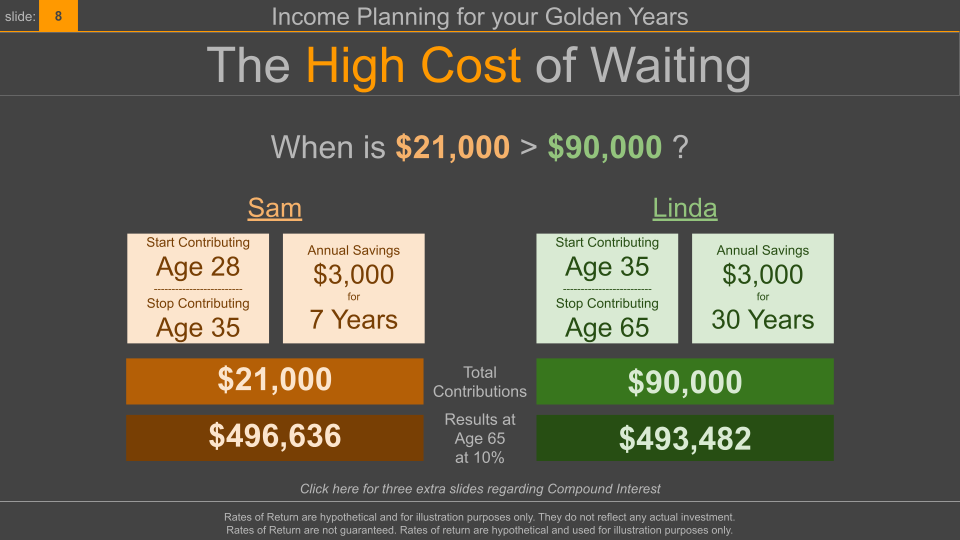
Let's compare Sam and Linda, two 28-year-olds contemplating saving for retirement in a long-term equity mutual fund earning an average of 10%:
-
Sam begin investing immediately and saves \$500 per month for seven years. Then he stops contributing due to family and other financial obligations. However, he doesn't withdraw any money and lets it compound until age 65 and ends-up with $496,636.
-
Linda, due to not having extra cash, decided to delay investing for seven years until she is 35. However, once she starts contributing she doesn't stop and continues until she is 65. She ends-up with $493,482.
Sam contributed \$21,000 and accumulated \$496,636. Linda contributed \$90,000 and accumulated \$493,482.
This demonstrates both the power of starting early and the high cost of waiting.
Quote
“I don’t know what the seven wonders of the world are, but I know the eighth, compound interest.” ―Baron Rothschild
How It Works ― The Rule of 72
The simplest way to understand compound interest is the Rule of 72. It is a simplified formula that estimates the number of years it will take to double your investment.

The math behind it works because doubling is linked to how percentages compound over time. The exact calculation involves logarithms, which are used in higher-level math to solve problems related to exponential growth. But the Rule of 72 skips all the complicated calculations by relying on a close approximation that works well for most realistic growth rates.
It’s not perfect — its accuracy wobbles with very high or very low interest rates — but for rates between 4% and 15%, it’s remarkably accurate. Economists trace its origins to 15th-century merchants who marveled at the power of compounding long before financial calculators existed.
The correct rule should be:
69.3 / Interest Rate = Years to Double Money
But we use 72 instead of 69.3 because it has a lot of divisors so it can be easier to do mentally. For example, 72 divides cleanly into 1, 2, 3, 4, 6, 8, 9 and 12, allowing for a quick and simple division problem instead of using a compound interest calculator.
The power of compound interest is amplified by time ― the longer you keep it going, the more your money grows. But the reverse is also true.
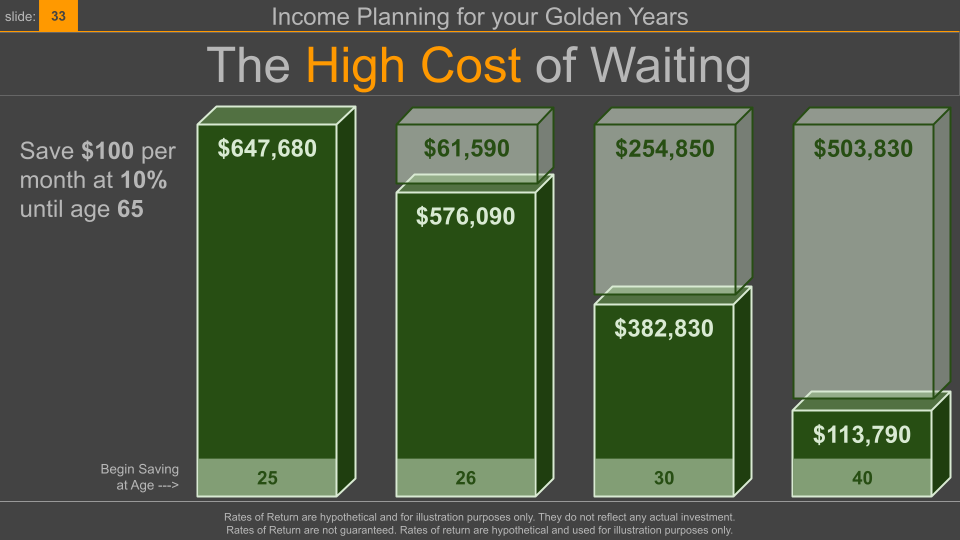
Focus Not on What it is Now, But What it Will Become
Resource
- Watch Sell the Future Value of Lump-Sums VIDEO
Always sell the future value of a lump-sum, not the current value.
For example, let's say a 35 year old client comes into a \$100,000 inheritance. In an effort to persuade her to invest it long term, don't talk to her about the "\$100,000", but instead the future-value at age 65, which is $1.7M at 10% ROR.
"So, have you thought about what you're going to do with your $1.7M."
Pro-Tip